

Kimberley Symon
Advisory Partner

Six months on from our last report, released in the lead-up to Budget 2026 in May, the much-anticipated fuel-supply crisis has not eventuated. Yet the absence of a single defining shock should not be mistaken for stability. While sections of the primary industry face favourable fortunes and Canterbury enjoys a strong residential construction sector, economic and political uncertainty remains a constant for many business leaders nationwide.
Budget 2026 delivered few major changes for business and with the 7 November General Election fast approaching, our September BPI survey results suggest business leaders are not relying on the political cycle to resolve key business pressures. Among the nearly 20 business performance metrics surveyed, business leaders report the lowest positivity regarding external economic and political factors. Meanwhile, expected positivity with their future overall business performance (in six months’ time) is at a record low. This implies that business leaders anticipate little upside from the election result on their business performance, regardless of the shape of the new coalition government.
While business leaders are exhibiting low positivity regarding their current business financials, cashflow and pipeline, these are also the few factors which they expect to be significantly more positive about in six months’ time - and measures which they have a greater ability to directly influence. This outlook perhaps indicates a degree of resilience and willing ambition to forge ahead with their business goals, despite continued political and economic uncertainty.
“This is a challenging time for many business leaders, and the results reflect that. But they're not putting their plans on hold. Despite ongoing financial pressure and uncertainty about the election outcome, many are backing their own ability to lift performance in the months ahead.” – Kimberley Symon, Advisory Partner, BDO Christchurch
It’s not surprising that there hasn’t been a huge shift in how business leaders are feeling about their current and future overall business performance since our last report.
Since our previous report in May 2026, there has been a 7% drop in positivity about current business financials with just 35% of business leaders feeling positive about this in the last two weeks – returning to the same record low reported in our previous two September surveys. This contrasts to the results in our previous two April surveys (just prior the Government’s Budget unveiling), where positivity has lifted.
In spite of this fluctuating sentiment regarding business financials, positivity regarding current overall business performance remains low, but steady (49%). As always, the percentage of business leaders expecting to feel positive regarding overall business performance in six months’ time is higher than at present – however this relative positivity regarding the outlook, has declined to a record low (52%). This suggests that regardless of the (presently uncertain) election result, business leaders aren’t anticipating any significant upsides for their business.
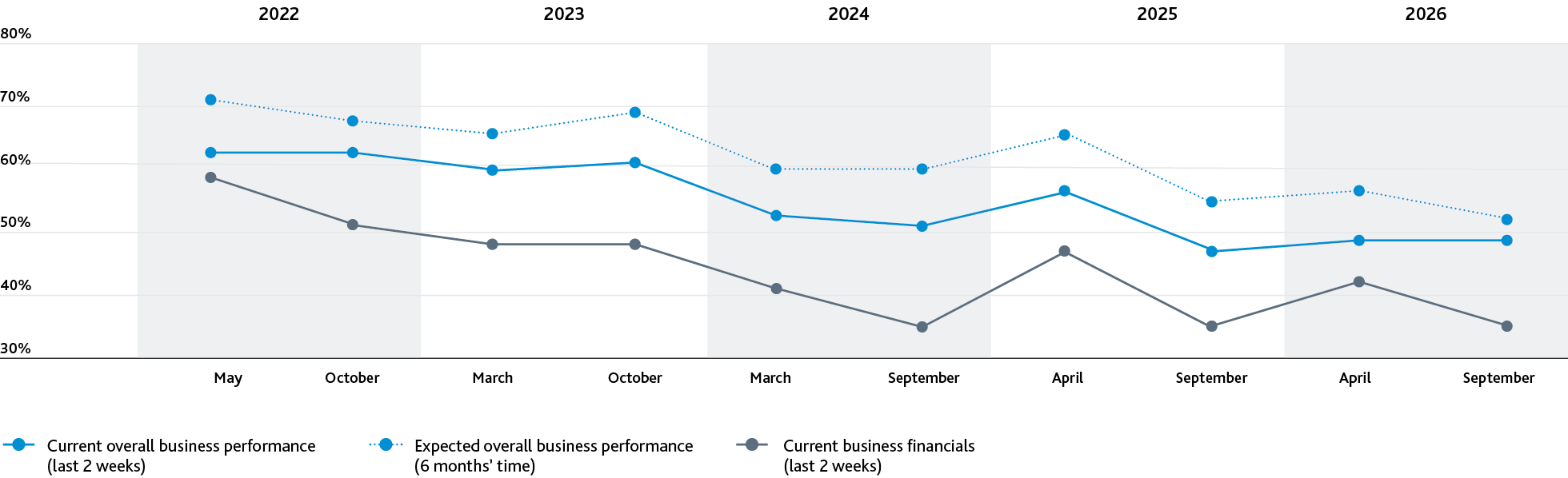
% Business leaders feeling positive (all or most of the time)
“We know from our conversations with clients that many business leaders are doing it tough. However, what these results also show – and what we're seeing first-hand – is that pressure on financial performance does not necessarily mean their business is standing still. Business leaders are continuing to serve customers, manage busy workloads and pursue growth, even when rising costs, tight margins and cash flow pressures mean that effort is not yet flowing through to the bottom line. That resilience, combined with smart business planning, provides a strong foundation for improvement as conditions improve.” – Kimberley Symon, Advisory Partner, BDO Christchurch
With the Election outcome in the balance, it's not surprising that political and economic uncertainty are the factors which business leaders remain least positive about. However, this uncertainty doesn't appear to be a barrier to increased positivity regarding the business financial performance, cash flow and business pipelines in the next six months - implying they don't view the Election outcome as being a key influence on their short-term business performance.
“It is understandable that business leaders are least positive about economic and political factors over which they have little control, particularly when changes in the wider environment can have a direct impact on demand, costs and investment decisions. However, with positivity regarding key factors relating to business finances expected to improve over the next six months, many business leaders appear to view the election as one of several external factors to navigate while they remain focused on the areas of their business they can more directly influence.” – Kimberley Symon, Advisory Partner, BDO Christchurch
 34%
 34%
 35%
 41%
 41%
% Businesss leaders feeling positive all or most of the time (last 2 weeks).
To view all of the issues facing business leaders click here.
"With a nail-biting election around corner you could perhaps expect to see some nervousness from the business sector. Rather, 'let’s get on' with it seems to apply. If you look at the actual data, there is little evidence of a material change in economic performance under a red or a blue banner either. Maybe there is a maturity developing where firms want to apply the Nike script: just do it. There are good reasons why election hand-wringing shouldn’t preoccupy us too much. Elections and governments come and go. Outside of the 2017-2023 government, who to be fair dealt with Covid, not much tends to change and common sense policy tends to prevail." – Cameron Bagrie, Bagrie Economics
Of particular note in the most recent survey, has been the emergence of climate risk management as one of the five lowest-scoring business performance factors – likely due to heightened awareness of the looming El Niño weather pattern and its potential impact on businesses, particularly those connected to agriculture and horticulture. Beyond observing its actual impacts over the upcoming summer, it will be interesting to track if this remains a short-term, seasonal concern for business leaders, or a continued focus. The heightened expected positivity regarding this factor in 6 months’ time, indicates presently many business leaders likely view El Niño as a short-term threat.
% Feeling positive in last 2 weeks* vs % expecting to feel positive in 6 months’ time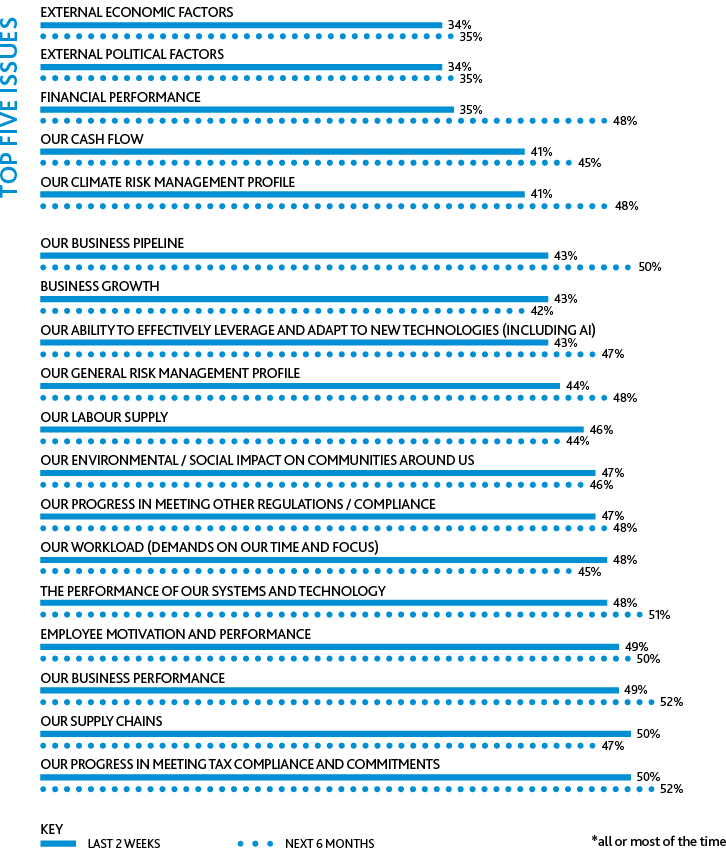
Positivity regarding business pipelines rises to 50%, from 43% currently, while positivity about workload and labour supply declines. This points to a practical capacity challenge. Businesses may need to prepare for stronger demand without placing unsustainable pressure on existing teams. The increase in recruitment intentions may be part of that response, with 24% planning to hire over the next 12 months, compared with 17% in May.
Supply chains were among the five lowest-scoring performance measures in May, likely due to global fuel supply uncertainty associated with the Middle East conflict. While positivity regarding this in six months’ time is expected to slip slightly, supply-chain pressure remains significantly less prominent than it was earlier in 2026.
"Let’s consider the barrage of other issues impacting businesses including global factors, fuel, mother nature (El Niño pending), climate change, labour supply and motivation and AI. The signals are pleasing in regard to the latter, with 47% of firms feeling positive about leveraging new tech and AI. New Zealand has a very clear productivity problem. Lacking productivity, incomes and living standards stagnant. Tech and AI is one of those rip-cords we need to be pulling hard to address woeful productivity performance." – Cameron Bagrie, Bagrie Economics
A range of topical factors stand out as top-of-mind for business leaders in successfully navigating our economic landscape over the year ahead.
 35%
Expect net profit to improve
(next 12mths)
 67%
Expect fuel prices to impact net profit
(next 12mths)
 9%
Very likely to be unable to
meet financial obligations
or experience insolvency
(next 12mths)
 20%
Actively hiring
(next 12mths)
 47%
Expect to feel positive about leveraging new tech & AI
(next 6mths)
We take a closer look at these issues in the sections below.
The September BPI survey highlights uneven business performance across regions and markets in New Zealand, which aligns with what we’ve seen over the last few years. However, there has been a reduction in positivity from Auckland businesses and a boost for those in the Rest of the North Island since our last survey.
% Business leaders feeling positive all or most of the time (last 2 weeks)
Mid-market businesses continue to outperform the wider business community across most key indicators, reinforcing their reputation as one of New Zealand's most resilient and growth-focused segments. More than three in five (61%) mid-market business leaders feel positive about their current business performance, compared with 49% across all businesses. Positivity is even stronger looking ahead, with 66% expecting to feel positive about business performance in six months' time, well above the national average of 52%.
Financial sentiment also remains significantly stronger than the broader market. Nearly half (48%) feel positive about their current financial performance, compared with 35% nationally, while 39% expect net profit margins to improve over the next 12 months.
Mid-market businesses also continue to invest for growth. More than one-quarter (28%) intend to actively recruit over the next 12 months, compared with 20% nationally, reflecting greater confidence in future demand and business opportunities.
However, cost pressures also remain a key concern. Three-quarters (75%) expect fuel-price inflation to have a moderate or significant impact on profitability, highlighting the continued challenge of managing operating costs in an uncertain environment.
Auckland’s earlier performance advantage has largely eroded, with business leaders becoming less positive across all business performance measures since April 2026. Positivity about current overall business performance has fallen from 56% to 48%, placing Auckland slightly below the national result of 49% and behind the Regional North Island at 56%.
The gap is most evident in business pipelines. Only 38% of Auckland leaders feel positive about their current pipeline, compared with 43% nationally and 57% in the Regional North Island. Auckland retains a modest lead in expectations for future business performance, but the results suggest businesses are entering the election period with a greater focus on securing demand and converting opportunities.
“This reflects what I’m hearing from clients: The picture is mixed. Some businesses are beginning to see conditions improve, while others remain subdued and do not expect a meaningful recovery until next year. There are still pockets of strong performance, particularly among exporters and specialist importers, but these remain the exception rather than the rule.” – Andrew Bathgate, Business Advisory Services Partner, BDO Auckland
Rest of North Island businesses report the strongest performance sentiment of the three geographies surveyed, with results improving across overall performance, financials and business pipelines. More than half (56%) feel positive about their current overall business performance, compared with 49% nationally, while 44% are positive about their current financial performance, against 35% nationally. Positivity about current business pipelines is particularly strong at 57%, well above the national result of 43% and Auckland’s 38%.
North Island businesses outside Auckland have also recorded the largest improvement in current overall business performance since May, rising from 44% to 56%. This relative strength is reflected in cash flow positivity at 50%, the 39% expecting profit margins to increase over the next 12 months, and the 23% planning to actively recruit. The dairying and horticultural heartlands encompassed in this area (from Waikato and Taranaki to Bay of Plenty), and the businesses that services these, are likely to be the mainstays of these survey outcomes.
“Six months on from the last survey, this renewed optimism from business leaders in the rest of the North Island is really interesting to see. The results indicate that businesses in the wider North Island are entering the election period from a position of relative strength, with a stronger platform for investment and growth than their counterparts elsewhere. However, it's likely that the positive trends in the Agribusiness sector, for example, are bolstering the regional result, with the North Island holding a major share of the country's agribusiness and farming operations. What I'm seeing on the ground in Wellington is that some business leaders are in a tough spot, which probably won't start to rebound until after the election. This is likely due to their proximity to government and in particular the flow on impact of the election cycle where new investment may be paused until the outcome is known. For business leaders who are still navigating a difficult trading environment, it's a good idea to revisit their business plan and strategy and evaluate whether changes are required to their strategic direction – those might be temporary alterations to get through the next 6-12 months, or perhaps represent an opportunity for a longer-term shift within existing markets or re-positioning into a new market.” – Justin Martin, National Advisory Leader, BDO Wellington
There has been much recent coverage of the strong relative economic performance of the businesses in the Canterbury region, fuelled by the financial health of local businesses in the agriculture and residential construction sectors. However, when these businesses are encompassed within the data set for the wider mainland business population on a per capita basis, the picture is less favourable. The latest BPI survey highlights that South Island businesses, as a whole, are facing similar pressures to those elsewhere in New Zealand – where the cost-of-living pressures and economic uncertainty have been particularly hard on retailers, tourism business and smaller businesses more broadly. In fact, South Island businesses exhibit the lowest business performance sentiment of the three geographies reported: Just 41% feel positive about their current overall business performance, compared with 49% nationally, although the result has improved modestly since May.
Current financial performance is the clearest pressure point: Only 20% of business owners in the South Island feel positive about this, up slightly from 18% in April but still the lowest result across all regions and sectors. Business growth, pipelines and cash flow also rank among the region’s weakest measures, pointing to continued pressure on demand and working capital.
There are still signs of cautious optimism: 47% expect overall business performance to be positive in six months, and 33% anticipate stronger profit margins over the next 12 months. However, with only 15% planning to recruit, many South Island businesses appear focused on strengthening cash flow, protecting margins and consolidating before pursuing growth.
| All Businesses | Mid-Market | Auckland | Rest of North Island | South Island | |||||
|---|---|---|---|---|---|---|---|---|---|
| Economic factors | 34% | Economic factors | 39% | Economic factors | 31% | Economic factors | 36% | Financial performance | 20% |
| Political factors | 34% | Political factors | 40% | Climate risk | 34% | Political factors | 36% | Economic factors | 28% |
| Financial performance | 35% | Supply chains | 45% | Political factors | 36% | Ability to leverage new tech & AI | 44% | Business growth | 29% |
| Climate risk | 41% | Workload | 45% | Financial performance | 36% | Financial performance | 44% | Business pipeline | 31% |
| Cash flow | 41% | Ability to leverage new tech & AI | 46% | Business pipeline | 38% | Cyber risk | 44% | Cash flow | 31% |
Lowest scoring business performance attributes (% of leaders feeling positive in last 2 weeks)
 68%
 44%
 62%
 40%
42%
 52%
% Business leaders feeling positive in last 2 weeks (all or most of the time)
Agribusiness leaders remain more positive in general than most sectors, but optimism has become more measured. Sixty-eight percent of agribusiness leaders report feeling positive about their current business performance, down 12% since our April 2026 survey. While there has also been a drop in positivity around future business performance, down to 59% from 83%, this is still higher than all other sectors, and the average for all businesses (52%). Expectations of improved net profit margins looking ahead twelve months suggests that agribusinesses see opportunities ahead, even if broader operating conditions remain uncertain.
Following the record low overall business performance sentiment reported by construction business leaders in our last survey (40%), there has been a lift in positivity around current (44%) and future overall business performance sentiment (50%) this time around. However, positivity toward current business financials has dropped further to 30%, the lowest across all sectors. It appears that construction businesses appear to be seeing improved activity levels and business opportunities, but many have yet to translate this into stronger financial results. Margin pressure and cost management remain critical priorities.
Māori businesses continue to demonstrate strong positivity, reporting higher levels of business performance positivity than the national averages. Across the broader Māori business sector, 62% of business leaders feel positive about their current business performance and 64% expect to feel positive about business performance in six months' time. We look forward to sharing further insights about this sector in our Māori Business Sector Report, which is due to be published on 19 November.
The outlook for the retail sector remains mixed. Positivity about current overall business performance is unchanged at 40%, while just 35% expect to feel positive about performance in six months’ time, down 30% since our last survey. However, positivity about current business financials has risen significantly, from 19% in April to 39% now. This suggests financial conditions may be improving for some retailers, even as softer demand, cost-of-living pressures and uncertainty about future trading conditions continue to weigh on the sector’s outlook.
The technology sector appears to be feeling the effects of softer demand and ongoing cost pressures, with current and future business performance sentiment and financial positivity declining. We can see a 10% drop in positivity towards current financial performance, which aligns with the reduction in the number of tech business leaders who expect net profits to improve in the next 12 months from 33% to 24% this time.
There has been no change to the current overall business performance or financials reported by tourism business leaders since our last report in May 2026. There has been a slight increase in positivity toward future business performance however, and a significant jump in the number of business leaders in this sector who expect higher net profit margins in the next 12 months, from 31% in the April survey to 49% now. This is higher than all other sectors and the national average of 35%.
Drawing on the latest Business Performance Index findings and her experience advising businesses, Kim shares her top practical tips to help business leaders navigate uncertainty, strengthen resilience and stay focused on the areas they can control.
Prepare for a range of post-election outcomes rather than relying on a single forecast.
“It could be a good idea to take some time to identify the policies that could have the greatest impact on your business, test the assumptions behind your business plan, and determine in advance what could trigger a change in investment, hiring or expenditure. Scenario planning will not remove uncertainty, but it can help leaders respond earlier and with more options.”
Read more about what the NZ General Election 2026 could mean for your business here.
Maintain a rolling short-term cashflow forecast and update it regularly as trading conditions change.
"Cashflow pressure rarely arrives without warning, but leaders need clear, current information to see it coming. Regularly stress-testing revenue, costs, debtor payments and financing assumptions — while keeping a close eye on receivables, stock, work in progress and major outgoings — can reveal pressure points early. That visibility gives businesses more time and more options, turning reactive decisions into deliberate action."
Review pricing, customer and product profitability, and the extent to which rising input costs are being recovered.
“Margin pressure can be easy to miss if leaders are focused only on revenue growth. Regularly comparing actual performance with budget helps reveal where returns are being eroded, while targeted efficiencies can protect profitability without weakening capability or customer value. Strong pricing discipline and timely reporting are what turn increased activity into sustainable returns.”
Plan for changes in leadership and ownership well before they're needed. This way the business can keep performing and hold its value whatever the future brings .
"Succession and exit planning are often left until a change is forced by health, family or market circumstances, yet the groundwork is the same discipline that strengthens a business today. Reliable cash flow forecasts, healthy margins, a well-qualified pipeline and a team that isn't reliant on one person all make a business more resilient now and more attractive to a future owner or buyer. Starting the conversation early – with whānau, key staff and trusted advisers – gives leaders more control over the timing, the outcome and their own wellbeing."
Start the conversation early about products that can ease pressure on working capital, such as trade finance, invoice finance or seasonal facilities.
“Working capital pressure often comes down to timing rather than profitability – paying suppliers before customers pay you, or carrying stock ahead of a busy season. Banks offer a range of products designed for exactly that gap, from trade finance for importers and exporters to invoice finance and seasonal facilities. The best time to have that conversation is before you need it. Going in with an up-to-date cash flow forecast and a clear view of your pipeline puts you in a stronger position to secure the right support on the right terms.”
Look beyond the headline value of the pipeline and assess its quality: Conversion probability, timing, margin, customer concentration and the certainty of revenue.
“A strong pipeline is not simply the one with the highest headline value; it is the one leaders can assess and plan around with confidence. Tracking where opportunities stall, challenging optimistic assumptions and aligning capacity with the work most likely to proceed provides a clearer view of future demand. A smaller, well-qualified pipeline can be far more valuable than a larger one with uncertain timing, margins or prospects of conversion.”
Before adding headcount, identify where better systems, clearer processes, automation or AI could remove low-value work and improve decision-making.
“Technology investment creates the most value when it is tied to a genuine business problem, supported by reliable data, capable people and appropriate governance. Where additional recruitment is still needed, leaders should connect those decisions to credible pipeline demand while ensuring growth does not come at the expense of sustainable workloads for existing teams.”
Business leaders do not need to carry financial and operational pressures alone.
“Business leadership can be isolating, particularly when financial and operational pressures begin to build. Regular conversations with trusted advisers, peers, governance groups and whānau can provide perspective, challenge assumptions and bring concerns into the open before they become urgent. Sharing the load is not a sign of weakness; it can help leaders make earlier, more deliberate decisions for both the business and their own wellbeing.”

Kimberley Symon