Subsector insights

BDO Construction Sector Report 2026

construction workers inside warehouse

How are construction subsectors performing in New Zealand in 2026?

Variability in subsector business performance remains one of the clearest indicators of how uneven construction sector health remains in 2026. Civil and infrastructure firms continue to report the strongest position overall, supported by longer work pipelines and public-sector investment. However, across all subsectors, the key issue is whether visible work can be converted into sustainable, well-managed revenue.

Compared with last year, the broad pattern is similar; civil and infrastructure firms remain better placed than residential and commercial businesses. What has changed is the nature of the opportunity. In 2025, the focus was on whether future infrastructure investment would translate into work. In 2026, the question is whether that pipeline can be delivered at pace and at sustainable margins, particularly as cost, funding and procurement risks remain elevated.

“The subsector story is not uniform. For civil and infrastructure firms, changes in government expenditure are critical because public investment has a direct influence on pipeline confidence. In residential construction, inflation continues to weigh heavily, particularly where higher costs are meeting more cautious demand. For commercial firms, the challenge is forward work, with uncertainty around future projects making it harder to plan, price and invest with confidence.” - Nick Innes-Jones, BDO National Construction Leader

Civil infrastructure, residential and commercial projects

Civil and infrastructure firms report the strongest current sentiment and forward work position. While their six-month outlook is more cautious, more of these firms expect gross profit margins to improve over the next year. 

Budget 2026 has since added further context to this outlook, with the Government announcing a $7 billion capital investment package for hospitals, schools, roads, rail and other public infrastructure. Because our survey closed before this announcement, the results do not yet capture how that investment may affect confidence, work pipelines or construction activity over the year ahead. The key question for civil and infrastructure firms will be how quickly announced funding flows through to funded, consented and deliverable projects. 

Read more about what the infrastructure could mean for construction business leaders here.

The stronger civil and infrastructure outlook is consistent with wider market commentary, revealing infrastructure as one of the more resilient parts of the sector. However, resilience does not remove risk. Government funding decisions, procurement timing, fuel costs and civil construction cost inflation can all influence tender pricing and project viability. For firms in this subsector, the opportunity is significant, but so is the need for strong cost control and disciplined contract management.


% Feeling positive about overall business performance  (last 2 weeks)


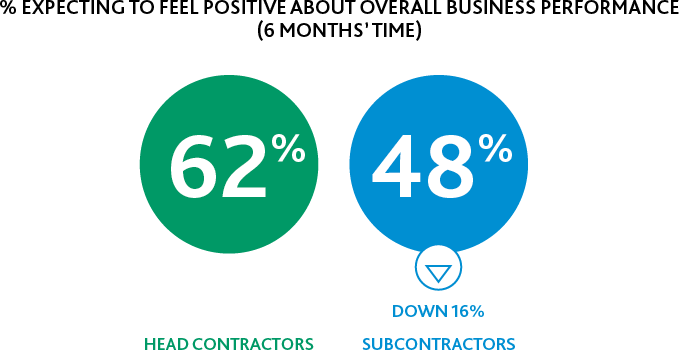
% Expecting to feel positive about overall business performance (6 months’ time)


Survey responses show civil and infrastructure firms are the most positive about their current business performance, although their positive sentiment eases when looking six months ahead. By contrast, residential and commercial respondents are more positive about the next six months than they are today, suggesting some expectation of gradual improvement from a lower base.

Longer pipelines are concentrated in civil and infrastructure


The forward work data reinforces that civil and infrastructure firms have a stronger pipeline than other subsectors. Fifty-seven percent of civil and infrastructure firms surveyed have sufficient confirmed work for more than 12 months.

Residential and commercial recovery remains fragile

Residential construction firms have the highest reported need for more work, at 8%, compared with 5% of commercial businesses. The heightened expectations of positive business performance sentiment in 6 months’ time among residential and commercial firms may reflect expectations that lower interest rates, improving economic sentiment or delayed projects will support activity over time. However, the data also suggests these subsectors remain commercially exposed. Residential firms report the greatest need for more work, while both residential and commercial businesses are more likely than civil and infrastructure firms to expect margins to fall. That points to a recovery that may be gradual and uneven, rather than a broad-based rebound.

Work secured does not always mean margin protected

The margin data highlights one of the most important messages for 2026; having work secured is not the same as having profitable work secured. Civil and infrastructure firms are the most optimistic about margin growth, with 28% expecting gross profit margins to increase over the next 12 months.

Businesses with increased gross profit margin 

(last 12 mths vs expectation for next 12 mths)

Civil / Infrastructure
29%
28%
Commercial
31%
19%
Residential
29%
20%
Key
Last 12 months
Next 12 months

 By contrast, commercial and residential firms are more likely to expect margins to fall, despite some improvement in forward sentiment. This suggests competitive tendering, cost escalation, scope changes and client affordability are still weighing on profitability.

Labour demand follows pipeline visibility


Recruitment intentions (next 12 months)


Labour demand is strongest where pipeline visibility is strongest. Civil and infrastructure firms are the most likely to be looking for staff, with 34% expecting to actively recruit over the next 12 months. This reflects stronger forward work, but also creates a challenge: Firms need sufficient capacity to deliver confirmed projects without overcommitting in a market where timing can still shift. Residential firms are less likely to be recruiting, with most saying current staffing levels meet their needs, which aligns with their shorter pipelines and greater need for new work.

Hot topics by subsector

Across each subsector, there is continued variability in how construction businesses are experiencing the current market. However, consistency is evident in business leaders maintaining focus on the practical issues that will shape resilience over the year ahead; protecting margin, managing cash flow, securing the right people and deciding where technology can genuinely improve productivity.

Civil and infrastructure firms appear better positioned on margin expectations and hiring intentions, reflecting their stronger pipeline visibility. However, they are less likely than other subsectors to identify technology and AI adoption as a priority. That creates an opportunity: As larger and more complex projects move through the pipeline, better use of technology could help improve estimating, project management, procurement, workforce planning and reporting. 

By contrast, the residential sector’s higher exposure to financial stress and insolvency risk highlights the pressure still facing businesses where demand is more sensitive to household confidence, funding conditions and affordability.


Civil / InfrastructureCommercialResidential
Expected net profit margin 
(next 12 months) – significantly/slightly higher
41%26%34%
Expected impact of fuel price inflation 
(next 12 months) – significant/moderate
71%70%71%

Very likely to be unable to meet financial obligations or experience insolvency (next 12 months)

2%4%6%
Recruitment intentions 
(next 12 months) – actively hiring
34%30%23%
Expect to feel positive about leveraging new tech and AI (next 12 months)48%52%57%

A stabilising market, but not an even one

The subsector picture for 2026 shows a market that is stabilising unevenly. Civil and infrastructure firms appear better placed, but their success will depend on how quickly pipeline turns into deliverable work and whether cost risks can be managed. Residential and commercial firms may be looking ahead with more optimism, but margin pressure remains a clear concern. For subcontractors, the challenge is sharper still; protecting cash flow, securing quality work and maintaining flexibility in a market where visibility can change quickly.


Head contractors vs subcontractors

The decline in business performance positivity among subcontractors this year is significant, and it points to the sharper pressures this part of the sector is facing. Fifty-eight percent of subcontractor business leaders were feeling positive about current business performance in our 2025 report, compared to 36% in this year’s survey. Expected future positivity (6 months’ time) has also declined from 64% in 2025 to 36% in our latest study.

The contrast with head contractors – whose positivity remains similar year on year - is important. Head contractors generally have earlier visibility over project pipelines, stronger relationships with clients and more ability to influence procurement, programme and contract terms. Subcontractors often come into the process later and are more exposed to timing changes, retentions, variation disputes and payment delays. This helps explain why sentiment can weaken quickly among subcontractors, even when there is still activity in the market.


% Feeling positive about overall business performance  (last 2 weeks)


% Expecting to feel positive about overall business performance (6 months’ time)

“Subcontractors typically have less visibility over future work than head contractors, with projects often confirmed later in the cycle. Many also operate with less balance sheet resilience, making them more exposed when pipelines soften, costs rise or payment timing becomes less certain.”  Ruth McGregor, Construction Partner, BDO Wellington


This is particularly important given most subcontractor respondents reported annual turnover below $10 million, suggesting many are smaller operators with less capacity to absorb volatility. The result is a more cautious outlook, where outlook can shift quickly even when there is still activity in the broader market.

Longer-term work is more visible for head contractors


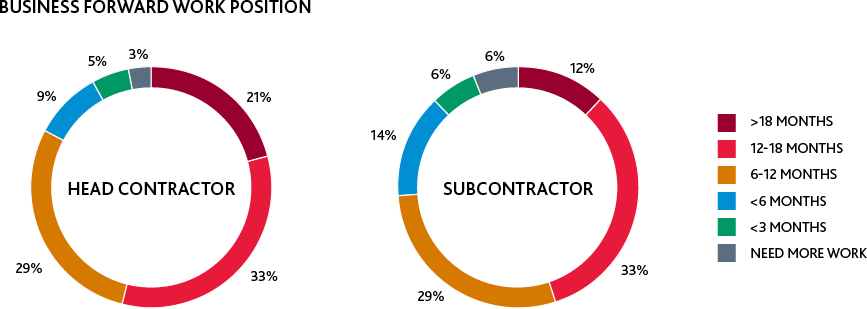
Business forward work position


Head contractors report stronger long-term pipeline visibility, while subcontractors are more likely to say they need additional work. This reinforces the different risk profiles across the contracting chain.

Businesses with increased gross profit margin 

(last 12 mths vs expectation for next 12 mths)

Head contractor
33%
29%
Subcontractor
16%
18%
Key
Last 12 months
Next 12 months

Subcontractor positivity is stabilising, but remains fragile

While subcontractor business leaders expect to be somewhat more positive about business performance in six months’ time than their current performance, that improvement comes from a much lower base than last year. This suggests positive sentiment may be stabilising, but remains fragile. Any expected margin improvement should also be read carefully, as subcontractors remain exposed to timing changes, payment delays and cost increases that can quickly erode profitability.

Key takeaways for construction business owners

  • Price the risk, not just the job. Build in realistic allowances for cost escalation, programme delays, labour availability and scope changes.
  • Separate pipeline value from pipeline quality. Confirm whether work is funded, consented, contracted and deliverable, not just visible in the market.
  • Protect margin through contract discipline. Review escalation clauses, variation processes, payment terms, retentions and termination risk before committing.
  • Use staffing decisions carefully. Recruit where work is genuinely confirmed, but maintain flexibility where pipeline timing remains uncertain.
  • Watch working capital closely. Growth in forward work can still create cash pressure if payment timing, materials costs or project delays are not managed.
  • Strengthen project selection. In a competitive market, turning down poorly priced work may be as important as winning new work.


Hot topics by contractor type

Head contractors are generally more optimistic than subcontractors across the key measures – a consistent theme across this year’s report.


Head contractorsSubcontractors
Expected net profit margin 
(next 12 months) – significantly/slightly higher
36%30%
Expected impact of fuel price inflation 
(next 12 months) – significant/moderate
67%78%

Very likely to be unable to meet financial obligations or experience insolvency (next 12 months)

1%2%
Recruitment intentions 
(next 12 months) – actively hiring
36%30%
Expect to feel positive about leveraging new tech and AI (next 12 months)52%
48%


Cost, cash flow and confidence remain the biggest pressure points

Respondents were also asked to identify their greatest challenges over the next 12 months. Cost pressure is the dominant concern across both head contractors and subcontractors, but the nature of that pressure differs. Head contractors are more focused on demand, pipeline confidence and client affordability, while subcontractors appear more exposed to immediate cost, cash flow and labour pressures.

“The survey highlights a sector under sustained pressure. Rising costs, tight margins and cash flow concerns are front of mind, alongside ongoing challenges in attracting and retaining skilled workers. What stands out is the growing uncertainty around pipeline and demand, with many businesses navigating reduced confidence and delayed decision-making from clients. In this environment, managing cost, risk and workforce capability will remain critical to maintaining resilience.” Ruth McGregor, Construction Partner, BDO Wellington


For business owners, these findings reinforce the importance of reviewing forward work, cash flow and contract exposure together rather than in isolation. Firms should be stress-testing project margins, checking payment terms, planning workforce needs against confirmed work and identifying where client or supplier risk could affect delivery.

View our report sections