Current workloads are not translating evenly into future positivity

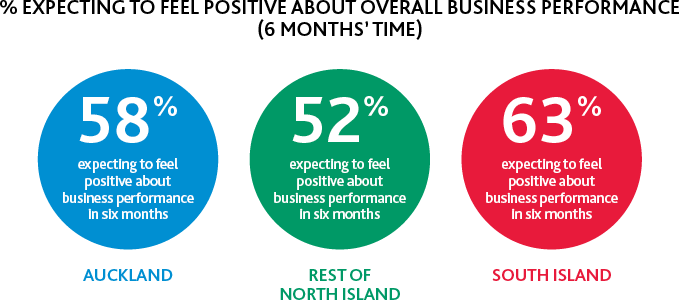
The data shows that businesses in the rest of the North Island are feeling the most positive about their current business performance, but that they are the only region expecting to be less positive in six months’ time. This may indicate that local businesses are busy now, but less confident that today’s activity will translate into a stable pipeline beyond the near term. Comparatively, businesses in Auckland and the South Island are expecting to feel more positive about their overall business performance in six months’ time. In fact, the South Island leads the forward work outlook, with continued development activity and demand in parts of the housing market.
Recent market commentary suggests that Queenstown’s property market is emerging as a clear outlier in New Zealand’s housing downturn. Strong demand from high-net-worth international and trans-Tasman buyers is sustaining development activity in the area. High price points, limited land supply and tourism-driven demand allow projects to remain financially viable despite elevated costs, supporting pockets of work in the area, even as the broader pipeline weakens. However, the South Island results should not be read as a Queenstown story alone. The region includes a mix of markets, from Canterbury’s more diversified construction base to tourism-linked areas where visitor activity and population movement continue to support demand.
“Queenstown’s property boom highlights a two‑speed construction market in New Zealand: While national building activity remains subdued, strong investor demand in the Wakatipu region is sustaining development. It offers short‑term relief for parts of the sector but also underlines that this resilience is localised, reliant on niche capital flows, and unlikely to offset broader construction challenges nationwide.” – Bjorn De Nijs, Construction Partner, BDO Southern Lakes & Central Otago
Forward work is strongest where demand is most resilient
The South Island has the strongest confirmed work position, with no South Island respondents reporting that they need additional work and 82% have sufficient confirmed work for at least 6 months.
Five percent of Auckland construction businesses report that they need more work and 74% have sufficient confirmed work for at least 6 months. In addition, a quarter of Auckland construction firms surveyed have sufficient confirmed work for 12 to 18 months, higher than other regions. This suggests there are still meaningful opportunities in the Auckland market, particularly for firms with the capability to compete for larger, more complex or better-funded projects. However, the combination of subdued residential activity, softer commercial conditions and heightened tender competition means business owners need to be selective. In Auckland, resilience may depend on choosing work with strong client funding, realistic programme assumptions and enough margin to absorb delay or scope risk.
“Auckland is still an active market, but it is also a much more selective one. Recent sector commentary points to a subdued residential pipeline, softer commercial conditions and greater competition for work, while civil, infrastructure and industrial projects are providing more resilient pockets of activity. For many construction firms, the challenge is not simply finding opportunities but converting the right work into profitable projects at a time when delays, feasibility pressures and tighter margins are still shaping decision-making.” – Nick Innes-Jones, BDO National Construction Sector Leader
For Auckland firms, this points to the importance of disciplined bid selection, careful client due diligence and realistic pricing for delay risk.
Despite fewer businesses in the rest of the North Island expecting to feel positive about business performance in six months’ time, they have the most confirmed work for this period. This suggests sentiment in the rest of the North Island may be shaped less by immediate workload and more by concerns about what comes next. Short-term confirmed work can support activity, but if future demand is uncertain, margins are tight or project timing is unclear, business owners may still take a cautious view of the next six months. For firms in this position, the priority is likely to be converting near-term activity into reliable cash flow while continuing to build a more resilient medium-term pipeline.

“Central Otago continues to stand out as a high-growth market. Demand remains strong, particularly in residential development driven by population growth and ongoing migration into the region. However, the key constraint is delivery capacity, with labour, infrastructure and consenting all limiting how quickly projects can be brought to market” – Bjorn De Nijs, Construction Partner, BDO Southern Lakes & Central Otago
Activity alone is not enough – margins matter
The South Island also stands out on gross profit margins, with 39% of respondents reporting an increase over the past 12 months, compared with 23% in Auckland and 27% across the rest of the North Island. This may reflect a stronger mix of viable projects, better tender conversion or more disciplined pricing in parts of the region. However, it also reinforces an important point for the wider sector; activity alone is not enough. In the current market, the strongest operators are those converting work into profitable, well-managed projects.
The South Island also stands out on gross profit margins, with 39% of respondents reporting an increase over the past 12 months, compared with 23% in Auckland and 27% across the rest of the North Island. This may reflect a stronger mix of viable projects, better tender conversion or more disciplined pricing in parts of the region. However, it also reinforces an important point for the wider sector; activity alone is not enough. In the current market, the strongest operators are those converting work into profitable, well-managed projects.
Businesses with increased gross profit margin
(Last 12 mths vs expectation for next 12 mths)