Lease accounting and lease management: Year-end considerations
Lease accounting and lease management: Year-end considerations
As we draw closer to 31 March and 30 June year-end reporting dates, there will be entities that are:
- Starring down the barrel of another year-end of lease accounting pain, or
- Adopting lease accounting for the first time (i.e., those entities that will be preparing their first NZ IFRS (NZ IFRS (RDR) financial statements).
For those entities asking (respectively) either “There must be a better way?”…or…“What is the best way to approach this from day-1?”, then this article is definitely worth a read, as we:
- Identify where the pain points in practice appear to be, and
- Provide you with BDO’s approach towards a solution.
Background where the accounting requirements can create operational headaches in practice
Entities that report under NZ IFRS or NZ IFRS (RDR) have to apply on-balance sheet accounting for most of their leases as lessee (excluding short-term, and low-asset value leases).
Recalculations to the lease numbers need to continuously occur as and when there are changes to the lease population, including:
- Changes to various judgements and estimates (i.e., discount rates, use or non-use of renewal options, termination options, purchase options etc.
- Changes in lease payments as a result of rent review / CPI adjustments.
- Contractual modifications to live leases (i.e., increases/decreases in scope, changes in lease payments/renewal options/ lease term, etc.).
Whichever way an entity decides to management their lease data (i.e. whether by spreadsheet, or lease software, as described below), there are very practicable pros/cons/trade-offs for entities and their finance teams to (re)consider.
Observations in practice
For certain types of leases, and populations at a certain scale, the ongoing day-to-day management of accounting for leases can be particularly onerous on finance teams.
Around this time of year, we see an upward trend in entities and finance teams working through the complexities of lease accounting, where the specific application areas of NZ IFRS 16 Leases
continue to cause frustration and stress, particularly around:
- Technical aspects of lease accounting that apply to both ‘vanilla’ and bespoke aspects of lease arrangements.
- Another year-end managing the lease accounting on:
- Spreadsheets (that with each passing year are becoming larger, less stable, and potentially more prone to error and/or omission).
- While many entities have managed to “survive” managing their lease accounting on spreadsheets, more and more entities (and in particular, their auditors) are calling time on this approach.
- Lease accounting software, but where resource/personnel is limited (or in some cases, has exited the business during the year).
- Entities that have elected to implement lease accounting software are finding that in some cases this is not necessarily the silver bullet initially envisioned.
- With high staff turnover, and other operational priorities at play, entities are finding that the continuity/ability of staff who know how to use their lease software may have become limited at best, and non-existent at worse.
- Spreadsheets (that with each passing year are becoming larger, less stable, and potentially more prone to error and/or omission).
Accordingly, we are finding more and more entities are either:
- Moving off Spreadsheets and onto licenced lease software, or outsourced arrangements.
- Discontinuing their licenced lease software and moving onto outsourced arrangements.
BDO’s proven solution
Since the adoption of NZ IFRS 16 in 2019, BDO’s own lease accounting software, BDO Lead has supported entities with the opportunity to access our specialist lease accounting services via either:
1. Direct SaaS user licence providing access to BDO LeadFor those entities with large lease populations and/or who want to retain their own day-to-day operation of their lease population and management. |
2. BDO's Outsourced Managed Lease ServicesFor those entities with moderate-to-large lease populations who are looking to offload the day-to-day operation of their lease population and management, whilst still retaining the accuracy and other intrinsic benefits of lease software. |
Which types of lease portfolios get value from a BDO Managed Lease Services solution?
Entities with moderate-large property leases
|
Entities with a high volume of Plant and Equipment leases
|
While it may feel that a Managed Lease Services solution means that management loose visibility over their lease population during reporting periods, BDO Lead’s latest optional Dashboard feature allows management to be able to remotely observe key lease information.
Each dashboard focuses on a different stage of the lease lifecycle, enabling teams to move from high‑level trends to lease‑by‑lease detail in seconds.
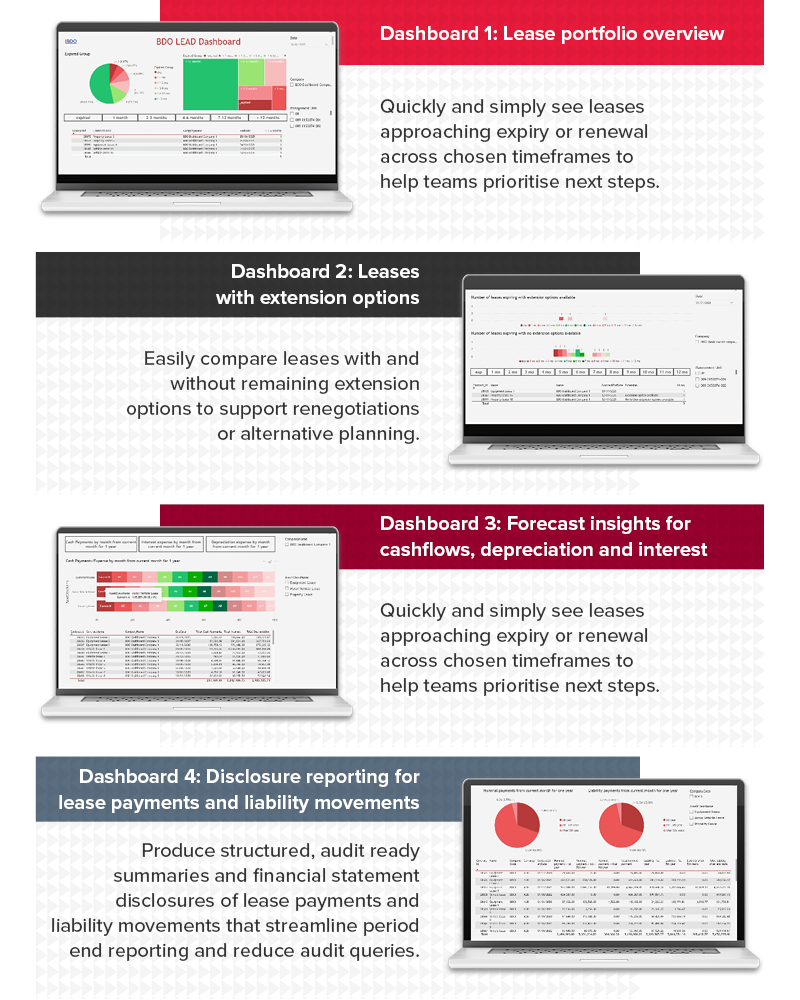
No matter how many leases an entity manages, the dashboards bring clarity, confidence and control to every stage of the lease lifecycle.
Planning for Year-end 2026, and beyond
If (moving onto) a BDO Lead solution is something that you feel would be valuable to your entity for the 2026 reporting period and/or future reporting periods, then please contact our Financial Reporting Advisory team to discuss further.
For more on the above, please contact your local BDO representative.