Getting your functional currency right

NZ IAS 21 The Effects of Changes in Foreign Exchange Rates requires that each entity to determine its functional currency, whether this be:

  • A standalone entity
  • An entity with foreign operations (such as a parent), or 
  • A foreign operation (such as a subsidiary or branch).

Accordingly, NZ IAS 21 requires that for accounting purposes foreign currency items are then translated into the entity’s functional currency

If however, an entity chooses a presentation currency different from its functional currency (as is permitted by NZ IAS 21), transactions and balances are translated again (i.e., from the functional currency into the presentation currency.

It is important to also note that (consolidated) ‘Groups’ do not have a functional currency

Rather, their financial statements are presented in their presentation currency, which may or may not be the same as the parent’s functional currency.

With some foreign currency translation differences recognised in profit or loss, and others in other comprehensive income (i.e., foreign currency translation reserves), using an incorrect functional currency can have a significant impact on an entity’s reported results.

In group financial statements, the results and financial position of each individual entity must be translated from their functional currency into the group’s presentation currency.

In this month’s article, we illustrate with examples the application areas that must be considered when an entity is determining the functional currency of an entity:

  • Example 1: Functional currency of an individual entity (overseas operations).
  • Example 2Functional currency of an individual entity (local operations).
  • Example 3: Functional currency of group entities (Parent holding company with a subsidiary with overseas operations).
  • Example 4: Functional currency of an entity that denominates its sales in a foreign currency.

Get in touch with our Financial Reporting Advisory team for assistance

Contact us
What is the functional currency?

An entity’s functional currency is the currency of the primary economic environment in which the entity operates (note: this may be different from the jurisdiction that the entity is incorporated in and/or operates from – see below).

How to determine an entity’s functional currency?

NZ IAS 21 has a hierarchy of indicators within paragraphs 9 to 12 to help entities determine their functional currency. 

This is not always a clear-cut process, particularly where entities operate across jurisdictions and transact in multiple currencies. 

Significant judgement is often required, and the factors supporting a conclusion of one functional currency over another should be noted as a significant judgement in the financial statements (NZ IAS 1, paragraph 122).

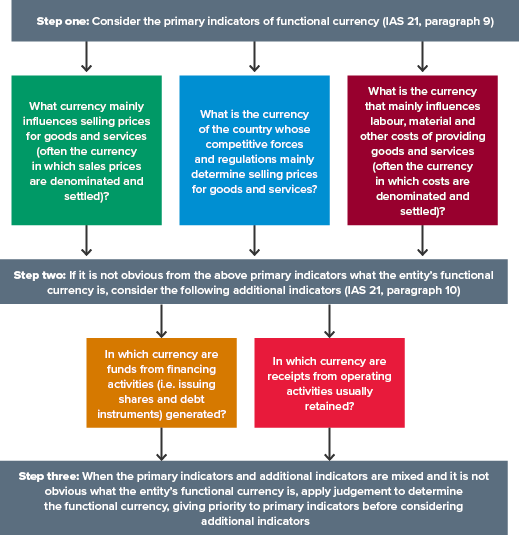
How does the functional currency hierarchy work?

The diagram below illustrates how the functional currency hierarchy operates. 

First, we consider the primary indicators, and if, and only if, those are not conclusive, there are additional (secondary) indicators that are considered. 

The hierarchy explicitly gives more importance to paragraph 9 (i.e. the primary indicators) than paragraph 10 of NZ IAS 21 (i.e. the additional (secondary) indicators). 

If an entity’s revenues and costs associated with generating those revenues are impacted by, say, US dollar (USD) movements, this is more significant in determining the entity’s functional currency than its funding arrangements.

Must the entity reassess the functional currency each year?

NZ IAS 21 does not require an annual reassessment of the functional currency. 

The entity’s functional currency reflects the underlying transactions, events and conditions that are relevant to it. 

Once determined, the functional currency, therefore, does not change unless there is a change in the underlying transactions, events, and conditions, in which case it must be reassessed.

Example 1 – Functional currency of an individual entity (overseas operations)

Relevant facts:

  • Company A is listed on the New Zealand Stock Exchange (NZX) and has a gold mine in South Africa. 
  • The South African workforce is paid in South African Rands (ZAR).
  • Capital equipment for the mine is purchased in US dollars (USD).
  • Gold produced by the mine is priced and sold globally in US dollars (USD).
  • Company A is financed by loans in New Zealand dollars (NZD), incurs listing fees in NZD, and pays its directors in NZD.

Observations

Step one - Consider primary indicators 

Primary indicators 
(NZ IAS 21, paragraph 9)

Currency

Comments

The currency that mainly influences selling prices for goods and services

USD

Globally, the sale price of gold is denominated and settled in USD. 

The currency of the country whose competitive forces and regulations mainly determine the selling prices for goods and services

USD 

Globally, changes in metal prices often correlate with changes in the USD.

The currency that mainly influences labour, material and other costs of providing goods and services

Mixed:
  • Labour costs paid in ZAR.
  • Capital equipment paid in USD.
  • Listing fees and directors’ fees paid NZD.

Capital equipment is likely to comprise the majority of the cost base of Company A (denominated in USD).


Based on the above, Company A concludes that its functional currency is the US dollar, and therefore, there is no need to assess the additional (secondary) indicators.

Example 2 – Functional currency of an individual entity (local operations)

Relevant facts:

  • Company B is listed on NZX and has a gold mine in New Zealand.  
  • The workforce is paid in NZD.
  • Capital equipment is purchased in USD, NZD, and Euros.
  • The gold produced by the mine is priced and sold globally in USD.
  • Company B is financed in NZD, incurs listing fees in NZD and pays its directors in NZD.  

Observations

Step one - Consider primary indicators 

Primary indicators 
(NZ IAS 21, paragraph 9)

Currency

Comments

The currency that mainly influences selling prices for goods and services

USD 

Globally, the sales price of gold is denominated and settled in USD. 

The currency of the country whose competitive forces and regulations mainly determine the selling prices for goods and services

USD

Globally, changes in metal prices often correlate with changes in the USD.

The currency that mainly influences labour, material and other costs of providing goods and services

Mixed

  • Labour costs paid in NZD
  • Capital equipment paid in USD, NZD, and Euros.
  • Listing fees and directors’ fees paid in NZD.

Capital equipment is likely to comprise the majority of the cost base of Company A (denominated in USD).


Although the costs incurred by Company B are denominated in various currencies, based on the primary indicator for goods and services, it concludes that its functional currency is the US dollar, and therefore, there is no need to assess the additional (secondary) indicators.

Example 3 – Functional currency of group entities (Parent holding company with a subsidiary with overseas operations)

Relevant facts:

  • Parent Co is listed on the NZX and has a gold mine in South Africa, which operates through Subsidiary Co. 
  • Subsidiary Co pays its South African workforce in ZAR, purchases capital equipment in USD
  • The gold produced the mine is priced and sold globally sold in USD.
  • Parent Co is financed by loans in NZD, incurs listing fees in NZD, pays its directors in NZD and pays dividends to its shareholders in NZD. 
  • To date, Subsidiary Co has not declared or paid any dividends to Parent Co.

Observations – Subsidiary Co

Step one - Consider primary indicators 

Primary indicators 
(NZ IAS 21, paragraph 9)

Currency

Comments

The currency that mainly influences selling prices for goods and services

US dollars

Globally, the sales price of gold is denominated and settled in USD. 

The currency of the country whose competitive forces and regulations mainly determine the selling prices for goods and services

US dollars

Globally, changes in metal prices often correlate with changes in the USD.

The currency that mainly influences labour, material and other costs of providing goods and services

Mixed:

  • Labour costs paid in ZAR.
  • Capital equipment paid in USD.

Capital equipment is likely to comprise the majority of the cost base of Company A (denominated USD).


Based on the above, Subsidiary Co concludes that its functional currency is the US dollar, and therefore, there is no need to assess the additional (secondary) indicators.

Observations – Parent Co

Step one - Consider primary indicators

Primary indicators 
(NZ IAS 21, paragraph 9)

Currency

Comments

The currency that mainly influences selling prices for goods and services

N/A

Parent Co does not generate revenue from providing goods and services. 

Its only source of income is dividend income from Subsidiary Co, for which it has received none to date.

The currency of the country whose competitive forces and regulations mainly determine the selling prices for goods and services

N/A

As above.

The currency that mainly influences labour, material and other costs of providing goods and services

N/A

Parent Co does not provide any goods or services.


Step two - Consider additional indicators

Additional indicators 
(NZ IAS 21, paragraph 10)

Currency

Comments

The currency in which funds from financing activities are generated

NZD

Funds raised on NZD and NZD denominated loan funding.

The currency in which receipts from operating activities are usually retained

NZD

Dividends paid to shareholders will ultimately be paid in NZD.


In considering the additional (secondary) indicators, Parent Co concludes that its functional currency is NZD

Note that there is no Group functional currency. 

In this example, Parent Co’s functional currency is NZD and Subsidiary Co’s functional currency is USD. 

If Parent Co’s presentation currency is NZD, the results of Subsidiary Co are translated from USD into NZD, with differences recognised in other comprehensive income (i.e., Foreign currency translation reserve (FTCR)).


Alternative view

Another acceptable view would be where Parent Co concludes that it has the same functional currency as Subsidiary Co because:

  • Parent Co essentially has no activities of its own other than raising funds, incurring listing and directors’ fees, and ultimately paying dividends to shareholders
  • Parent Co’s ability to service its debts and pay dividends to shareholders is dependent on the performance of Subsidiary Co’s gold mine, whose functional currency is USD.
  • Parent Co is acting as an extension of Subsidiary Co.

While paragraph 11 of NZ IAS 21 provides additional factors to consider when determining the functional currency of a foreign operation (one of them being whether the activities of the foreign operation are carried out as an extension of its parent), the reverse does not necessarily apply. 

However, Parent Co may analogise to NZ IAS 21, concluding that Parent Co is acting as an extension of Subsidiary Co, and that Parent Co’s functional currency is, therefore, USD. 

Parent Co could reach two possible conclusions regarding its functional currency. 

It is, therefore, crucial for them to disclose the fact that they have made a significant judgement, as well as sufficient information explaining the basis for that judgement (see NZ IAS 1, paragraph 122).


Example D – Functional currency of an entity that denominates its sales in a foreign currency

Relevant facts:

  • Company C is listed on the NZX and provides IT software and cloud storage solutions to customers all over the globe.
  • Company C chooses to denominate its sales prices in USD, as commercially the USD is widely traded around the globe compared to the NZD. Other competitors to Company C in various jurisdictions may (or may not) also choose to denominate their sales prices in USD, or another currency (including their local currency).
  • The workforce is paid in NZD.
  • Capital equipment is purchased in USD, NZD, and Euros.
  • Company B is financed in NZD, incurs listing fees in NZD and pays its directors in NZD.  

Observations

Step one - Consider primary indicators 

Primary indicators 
(NZ IAS 21, paragraph 9)

Currency

Comments

The currency that mainly influences selling prices for goods and services

NZD

The sales price of Company C’s goods and services are denominated in USD, however they are largely determined on NZD denominated input costs. 

The currency of the country whose competitive forces and regulations mainly determine the selling prices for goods and services

N/A

Globally, changes in sales price Company C’s goods and services do not correlate with changes in a single (“common”) currency.

The currency that mainly influences labour, material and other costs of providing goods and services

Mixed:

  • Labour costs paid in NZD, or the local currency in which the workforce (sales teams) operate.
  • Capital equipment paid in USD, NZD, and Euros.
  • Listing fees and directors’ fees paid in NZD.

Capital equipment is likely to comprise the majority of the cost base of Company A (denominated USD).


Based on the above, Company C concludes that it is not clear what the function currency is from assessment of the primary indicators, and therefore there is a need to assess the additional (secondary) indicators.

Step two - Consider additional indicators 

Additional indicators 
(NZ IAS 21, paragraph 10)

Currency

Comments

The currency in which funds from financing activities are generated

NZD

Funds raised on NZD and NZD denominated loan funding.

The currency in which receipts from operating activities are usually retained

NZD

While Company C receives sales revenue in USD, in must (continuously) convert this into NZD to settle a substantial portion of its operating expenditure, debt repayment, and distributions to shareholders.


In considering the additional (secondary) indicators, Company C concludes that its functional currency is NZD


Need help

Please contact our Financial Reporting Advisory team for assistance in your entity’s determination of its functional currency.

For more on the above, please contact your local BDO representative.

This article has been based on an article that originally appeared on BDO Australia, read the original article here.