Disclosures requirements regarding covenants are required for Tier 1 and Tier 2 (RDR) reporters
Disclosures requirements regarding covenants are required for Tier 1 and Tier 2 (RDR) reporters
For entities that borrow funds (i.e., from banks, etc.), these are often subject to compliance with specific covenants (i.e., ‘tests’) that are assessed periodically over time – where if breached, will typically provide the lender with the right to demand immediate repayment.
For accounting purposes, the key question has always been how these covenants interact with financial reporting standards in terms of whether borrowing balances are required to be presented as ‘current’, or ‘non-current’.
For For-profit entities (‘FPEs’) reporting under NZ IFRS or NZ IFRS (RDR), an amendment back in 2024 provided additional guidance on this area.
For Public Benefit Entities (‘PBE’) reporting under PBE IPSAS and PBE IPSAS (RDR), these same amendments will be effective this year (from 1 January 2026).
These amendments have also introduced additional general disclosure requirements regarding an entity’s covenants, including for Tier 2 reporters (i.e., there is no RDR exemption).
While the application of the changes to the ‘current’ versus ‘non-current’ presentation requirements have largely been applied correctly across the board, the disclosure requirements have been less consistent.
In this article we provide entities with a reminder of these disclosures, which apply irrespective of whether or not the entity has breached these covenants before reporting date, or is expected to breach these subsequent to reporting date.
For PBEs the equivalent standard PBE IPSAS 1 Presentation of Financial Statements (‘PBE IPSAS 1’) was also amended, and will be mandatorily effective from this year (reporting periods beginning 1 January 2026).
In summary, these amendments require :
While the standard setters decided that the presence of this covenant testing situation would not impact presentation, they did decide that disclosures regarding this situation would be required (NZ IAS 1 para 76ZA, and PBE IPSAS 1 para 87A).
The XRB subsequently decided that all Tier 1 and Tier 2 reporters should be required to make these disclosures (i.e., there is no RDR exemption).
The general disclosures require that an entity disclose both:
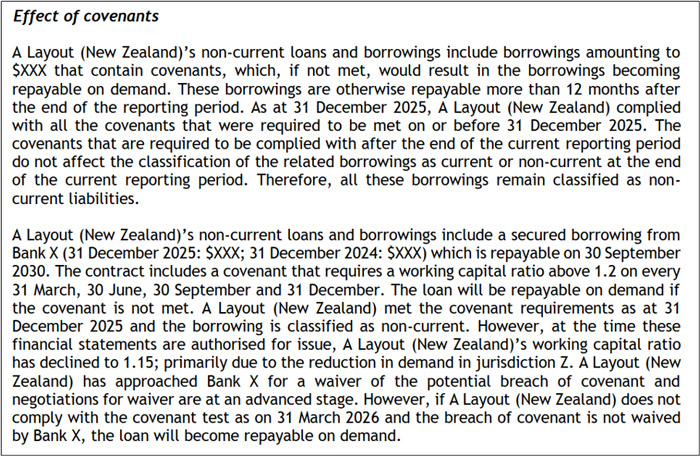
An illustrative example of these disclosures (from BDO New Zealand’s Illustrative Financial Statements series) is shown below:
For more on the above, please contact your local BDO representative.
For accounting purposes, the key question has always been how these covenants interact with financial reporting standards in terms of whether borrowing balances are required to be presented as ‘current’, or ‘non-current’.
For For-profit entities (‘FPEs’) reporting under NZ IFRS or NZ IFRS (RDR), an amendment back in 2024 provided additional guidance on this area.
For Public Benefit Entities (‘PBE’) reporting under PBE IPSAS and PBE IPSAS (RDR), these same amendments will be effective this year (from 1 January 2026).
These amendments have also introduced additional general disclosure requirements regarding an entity’s covenants, including for Tier 2 reporters (i.e., there is no RDR exemption).
While the application of the changes to the ‘current’ versus ‘non-current’ presentation requirements have largely been applied correctly across the board, the disclosure requirements have been less consistent.
In this article we provide entities with a reminder of these disclosures, which apply irrespective of whether or not the entity has breached these covenants before reporting date, or is expected to breach these subsequent to reporting date.
Background
For FPEs, an amendment to NZ IAS 1 Presentation of Financial Statements (‘NZ IAS 1’) was made back in 2024 clarifying how covenants affect the classification of a liability (i.e., the ‘current’ vs ‘non-current’ question).For PBEs the equivalent standard PBE IPSAS 1 Presentation of Financial Statements (‘PBE IPSAS 1’) was also amended, and will be mandatorily effective from this year (reporting periods beginning 1 January 2026).
In summary, these amendments require :
- That only covenants that must be complied with on or before reporting date affect the classification of a liability as ‘current’ or ‘non-current’ (and provide additional guidance on the treatment of ‘waivers’ and ‘periods of grace’ provided by lenders).
- Entities must disclose information to enable users to understand the risk that non-current liabilities with covenants could become repayable within twelve months.
General disclosure requirements
In applying the requirements of (1) above, an entity may be required to classify it borrowings as ‘non-current’ even when the borrowings are subject to covenant testing within twelve months after the reporting period (which then if breached, would permit the lender to demand immediate repayment).While the standard setters decided that the presence of this covenant testing situation would not impact presentation, they did decide that disclosures regarding this situation would be required (NZ IAS 1 para 76ZA, and PBE IPSAS 1 para 87A).
The XRB subsequently decided that all Tier 1 and Tier 2 reporters should be required to make these disclosures (i.e., there is no RDR exemption).
The general disclosures require that an entity disclose both:
- Information about the nature of the covenants (i.e., what they are, when they must be complied with, the carrying value of the associated borrowings).
- Facts and circumstances that indicate the entity may have difficulty in complying with these covenants in the future.
An illustrative example of these disclosures (from BDO New Zealand’s Illustrative Financial Statements series) is shown below:
Need help?
Please contact our Financial Reporting Advisory team for further assistance on the changes to NZ IFRS and PBE IPSAS with respect to the presentation and disclosure requirements associated with borrowings that are subject to covenants.For more on the above, please contact your local BDO representative.